
Friday, 17 December 2010

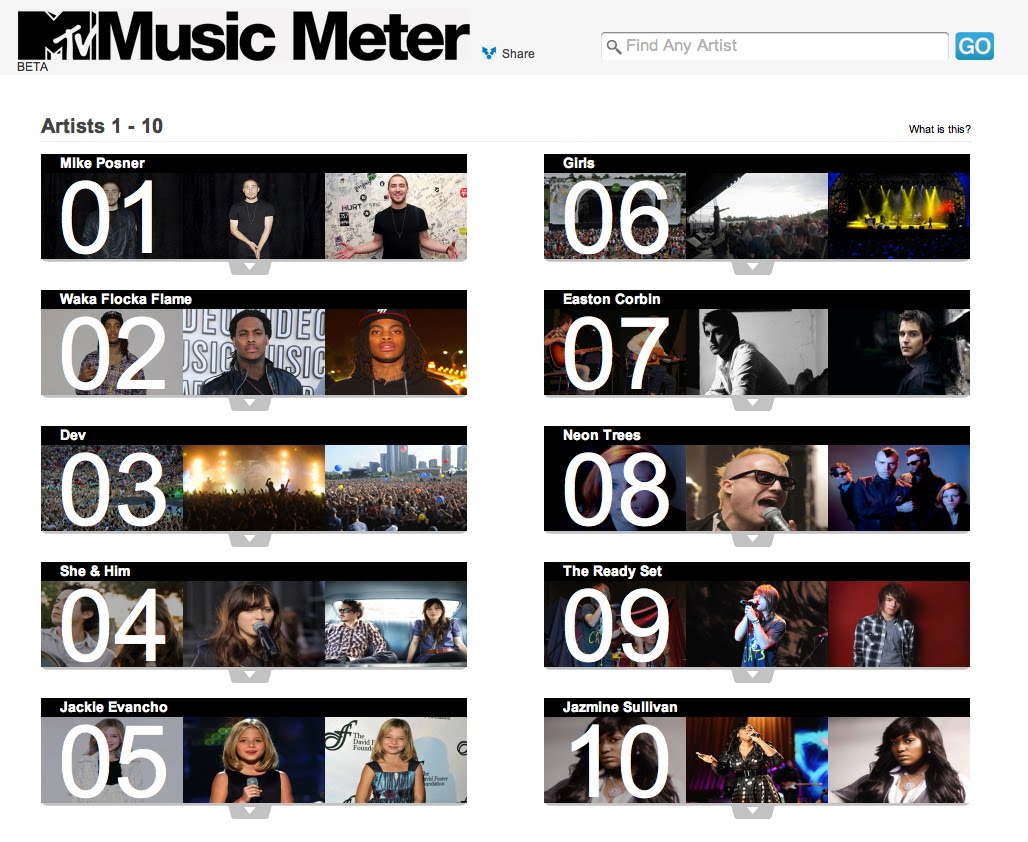
Why MTV's New Music Meter Matters


Here's a new article by our friend Jeff Pollack from Pollack Media for Huffington Post:

"It's time for music discovery platforms to catch up with their users. There are plenty of services out there that will collect lists of new artists or provide the user a group of artists that sound similar to one the user has entered. While these sites are useful and were amazing when they first launched, the increased ease accessibility of all things, especially media, on the Internet, is rapidly dating these sites. Today, the average music fan has come to expect a product that is nearly infinite in catalog and provides them with a unique experience which, at the same time, is clean, organized, and intuitive. As MTV prepares to launch its new Music Meter, they seem to have this modern fan in mind and have developed a platform that makes discovering new music and artists a much more active and user-controlled experience.

Before the Internet, on-demand services, and iPods gave all of us musical ADD, MTV was where music fans would go to watch their favorite clips and discover new ones (full disclosure, they are a long time client). With the new Music Meter, which MTV describes as "a quick and easy way to discover new music - a daily list of lesser known artists that music fans are listening to, talking about and sharing across the internet and the real world ", it seems that the network has once again tapped in to how the next generation wants to experience their favorite music and be exposed to what's new and what's next.

The Music Meter has a two-fold appeal: it ranks the 100 most buzzed about new artists (on and offline) and provides a music recommendation service. (...)

This is on-demand music discovery. It's interactive, user-controlled, and can last a few minutes or hours. Pretty cool. (...)"

This is just an excerpt. Please find the whole article here.

Photo courtesy of MTV Networks

Thursday, 25 November 2010

Apple kills the Radio App – folgt Facebook?


Das App-Verbot von Apple kann im wahrsten Sinne zur Killer-Application von Radio werden. Zumindest verdeutlicht es zwei Punkte:

1) Das Image von Radio in der New Media Welt ist nicht besonders gut.
Wenn Apple Radioprogramme als ‚Spam‘ bezeichnet, ist das ein Imageschaden von unbeschreiblichem Ausmaß.

2) Bleibt Apple bei seiner Entscheidung, verliert Radio darüber hinaus seinen wichtigsten Touch Point zu den Meinungsführern an den iPhones.

Es geht primär um das Image einer ganzen Branche, die nicht verstehen will, dass sich mit einem schlechten Gattungsimage in Zukunft unter Umständen weniger Geld verdienen lässt als mit einem noch nicht ganz klaren Geschäftsmodell.

Umso wichtiger ist es deshalb, dass Radiosender beim Thema Social Media kurzfristig mehr Gas geben.

Facebook zum Beispiel bietet Radiosendern die einmalige Chance, die Kundenkommunikation zu verbessern und Glaubwürdigkeit bei Hörern und Werbern aufzubauen.

Ein Radiosender, der Facebook nicht als Verkaufskanal versteht, sondern als Quelle für Co-Creation mit den Hörern sowie als Touch Point mit Meinungsführern, schlägt drei Fliegen mit einer Klappe:

1) Hörergetriebener Content (überraschend, kreativ, glaubwürdig, hörernah, günstig)

2) Innovatives Branding

3) Marktforschung mit Fans (Feedback vom Hörer zum Programm)

Keep Going!!!

Monday, 22 November 2010

Happy Birthday, Totalni FM!


In this case we really mean "birthday" because last Wednesday morning, a new nationwide radio station network in Croatia started going on air.

Its name is Totalni FM.

Here’s a video the team made to capture the starting moments. Enjoy watching and listening!

Friday, 12 November 2010

Großer Frequenzenwechsel in Berlin steht bevor

4 Sender tauschen in Berlin ab 1. Dezember 2010 ihre Frequenzen.

Außerdem kommt wohl oldiestar auf der bisherigen Frequenz von Radio Paradiso neu hinzu im Berliner Radiomarkt, wozu jedoch eine endgültige gerichtliche Entscheidung noch aussteht.

Hier die Übersicht der alten und neuen Frequenzen in der Hauptstadt:


Quelle: radioWOCHE

Tuesday, 9 November 2010

Interview mit Stephan Schmitter


promedia - Das medienpolitische Magazin führte kürzlich ein Interview mit Radio Center Berlin Geschäftsführer Stephan Schmitter. Die wichtigsten Aussagen werden so zusammengefasst:

"Das analoge Radio funktioniert auf der einen Seite nach wie vor sehr gut, weil jeder problemlos seinen regionalen Lieblingssender und seine gewohnte Marke hören kann. Auf der anderen Seite sind wir längst in der Zukunft angekommen und bespielen alle digitalen Verbreitungswege, die aus unserer Sicht sinnvoll und bezahlbar sind", so der Geschäftsführer der beiden Berliner Radiosender 104.6 RTL und 105'5 Spreeradio. Diese Meinung verdeutlicht die Position der meisten privaten Radiosender. Während Regiocast weiter für eine nationale DAB-Verbreitung eintritt und sich auch für eine Frequenz beworben hat, lehnt die RTL-Radiogruppe DAB als Alternative zu UKW ab. "DAB oder DABplus ist für einen privaten Radioanbieter in der jetzigen Form nicht finanzierbar", so Schmitter.

Zugleich betont der RTL-Radiomann, dass die Nutzung der Radioangebote Online und über Apps deutlich zunimmt: "Unsere Apps werden momentan 10.000-fach heruntergeladen und landen regelmäßig in den Top Ten-Listen des App-Stores." Inzwischen seien mit den Apps auch Erlöse zu generieren. „Es ist ein Geschäftsmodell, das von Monat zu Monat, von Jahr zu Jahr besser wird. Das ist aus unserer Sicht vielversprechender als DAB."

Thursday, 21 October 2010

New UK webradio player will include public & private stations


A new online player for both public (BBC) and private radio stations from the United Kingdom was presented in England yesterday.

This is what British newspaper The Guardian writes about the project:

'iPlayer for radio' set for December launch
Radio streaming application containing content from BBC and commercial stations unveiled at Radio Festival in Salford

A BBC-backed radio streaming application with the potential to allow users access to audio content from more than 400 stations nationwide is to launch in December.

The first working version of the UK Radioplayer project – dubbed 'the iPlayer for radio' – was unveiled at the annual Radio Festival in Salford yesterday.

Content from about 50 radio stations, both BBC and commercial, will be available when the site goes live in December, with 150 more on board at the time of full commercial launch in February 2011.

Click here to read the whole article.

Tuesday, 5 October 2010

No, new music doesn't suck


Please enjoy this excellent article written for the Huffington Post by our partner Jeff Pollack in Los Angeles:

"I have been struck by the number of comments to some of my recent blogs about the continued deterioration of the traditional music business, that the main culprit (other than the greed of the labels) is the low quality of new music today. But it's simply not the case. This tired argument has been used by each succeeding generation after they pass through their primary music discovery years. Somehow, the music from the era they grew up in represented a special window of innovation and quality that will never be duplicated.

In the past 50 years, it's certainly true that there have been a handful of bands and artists whose originality, lyrics, and musicianship have provided us with timeless music that resonates with a wide range of ages. And among those artists, there are a small number of remarkable gems - what I like to call "100-Year Artists"- who like Gershwin, will be listened to forever. But these are few and far between, historical aberrations that emanated from the real world of contemporary music and transcended any era. We talk about Led Zeppelin and Pink Floyd still today because they were Led Zeppelin and Pink Floyd, not because they existed in the past.

It's easy to forget that the majority of music of every era and every genre was disposable. We forget that The Beatles flourished at the same time as Freddie and the Dreamers and Herman Hermits. Joplin and The Doors were released around the time of the Monkees and Tommy James. So many of the guilty pleasures of the 80's, like the Buggles and Flock of Seagulls, had little to do with real quality but were of a time, place, and mood. In each era, a few bands are truly great, but mostly the old disposable music is replaced by equally forgettable songs... no different than what is being produced by Idol today."

To read the whole article, please click here.